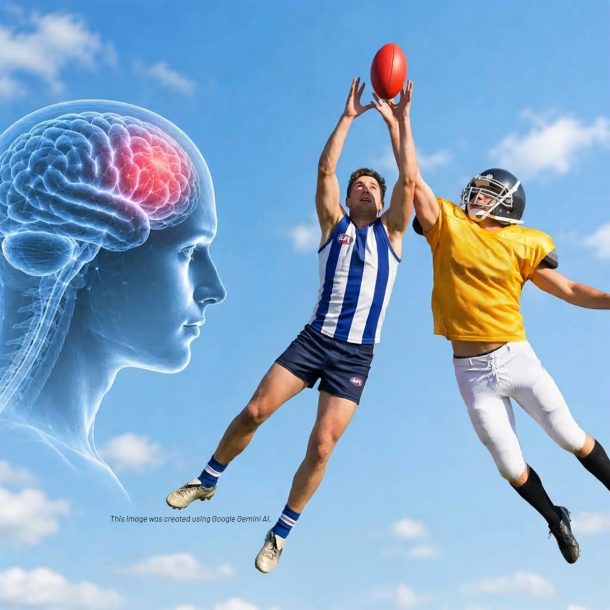
The United States and Australia are moving in the same direction on concussion-related liability, but they remain at very different stages of development. Schools, colleges, universities, athletic associations, and professional sporting organisations in the U.S. have faced more than a decade of litigation.1 This has resulted in significant settlements, more detailed concussion-management obligations, and pathways for class-actions and medical-monitoring claims.2
The National Collegiate Athletic Association (NCAA) is the principal governing body for collegiate athletics in the United States. The NCAA concussion litigation alone led to nationwide concussion-management obligations, baseline testing requirements, and a 50‑year medical monitoring regime for former student‑athletes.3
Australia, by comparison, remains at an earlier stage of the concussion litigation cycle. Current Australian claims primarily involve professional sport, particularly Australian Football League (AFL) players, club players, and medical practitioners. Although Australian courts are beginning to examine concussion-related negligence claims, there is not yet an Australian equivalent of the NCAA litigation involving universities or a concussion class action arising from participation in university sport.4
From an Australian insurance and underwriting perspective, the key conclusion is that Australian university concussion exposure is currently materially lower than the comparable exposure in U.S. collegiate sport, although long-tail liability trends indicate the gap may narrow over time.
United States – Established Exposure
The U.S. experience illustrates how concussion litigation can evolve into a significant source of institutional liability. The NCAA has been a central defendant in litigation alleging failures to protect student-athletes from concussion and repetitive head-impact risks.
The NCAA concussion class action alleged, among other matters, that the NCAA had failed to adequately protect student-athletes from concussion risks and failed to implement appropriate concussion-management procedures. The eventual settlement required NCAA member institutions to implement concussion-management plans, baseline testing, medical clearance protocols, and concussion reporting requirements. The settlement also established a medical monitoring regime for former student‑athletes.5
U.S. educational institutions have also faced direct negligence claims involving the day-to-day management of athletes. Allegations have included
- premature return-to-play decisions,
- inadequate medical assessment or follow‑up,
- failure to remove athletes from competition,
- inadequate supervision and training of coaches or other personnel, and
- failure to warn athletes about neurological risks.6
Reported U.S. school-level cases have resulted in verdicts and settlements ranging from approximately USD 300,000 to USD 4.4 million,7 while broader class actions involving the National Football League (NFL) and NCAA have exceeded USD 1 billion in aggregate settlement frameworks.8
Australia – Emerging but Developing Exposure
Australian concussion litigation continues to be concentrated in professional sport. The principal proceedings and related claims include the Rooke v. AFL group proceeding,9 the claim brought by Gary Ablett Sr,10 the Liam Picken litigation,11 and contribution claims involving AFL clubs and medical practitioners.12
The Rooke v. AFL Class Action
The most significant Australian concussion litigation is the ongoing Rooke v. AFL class action brought by former Geelong player Max Rooke on behalf of former AFL players. The claim alleges that the AFL and participating clubs failed to implement adequate concussion management measures, educate players regarding long-term neurological risks, and properly manage return-to-play decisions. The proceeding is expected to become a leading Australian authority concerning concussion-related duties of care and may influence future claims against sporting organisations, schools, and universities.13
The Gary Ablett Sr Claim
Former AFL player Gary Ablett Sr has commenced proceedings against the AFL and former clubs Geelong and Hawthorn, alleging failures to take reasonable care to protect him from concussion and repetitive head trauma risks. The matter is presently stayed pending the outcome of the Rooke proceedings.14
The Liam Picken Litigation
Former Western Bulldogs player Liam Picken has sued the AFL, the Western Bulldogs, and former club doctors, alleging failures in concussion management and medical oversight. The claim extends beyond sporting organisations and includes allegations concerning the conduct of medical practitioners.15
Related Club and Medical Practitioner Claims
A notable development within the Rooke proceedings is Geelong Football Club’s attempt to seek contribution from current and former club doctors concerning concussion-management decisions. This reflects an emerging trend towards multi-party litigation involving sporting bodies, clubs, and health professionals.16
Unlike U.S. colleges, Australian universities have not yet become a significant litigation target. There is currently no Australian equivalent of the NCAA concussion litigation or a concussion class action against universities arising from student sporting participation.
Why Australian University Exposure Currently Differs
Structure of University Sport
The most important distinction between Australian and U.S. university sports is structural. U.S. universities operate highly commercialised athletic programs through the NCAA. Universities recruit athletes, provide scholarships, employ coaching staff, maintain medical teams, and generate significant revenues from intercollegiate sport.17
By contrast, much Australian university sport is recreational or amateur in nature. National university competitions and related activities are facilitated through UniSport Australia rather than through a commercialised collegiate athletics system comparable to the NCAA. Participation levels, training intensity, media scrutiny, and financial stakes are substantially lower.18
Consequently, Australian universities face less exposure arising from
- recruitment practices,
- athletic scholarships, elite-performance expectations, and
- return-to-play pressures.
Damages and Litigation Environment
The U.S. remains a more severe environment for large concussion claims. Relevant features include large jury awards, the potential availability of punitive damages, broad class-action mechanisms, and substantial medical-monitoring liabilities. These factors can increase both individual claim severity and the aggregation potential of institutional exposures.
By comparison, the Australian liability environment is generally characterised by lower personal-injury awards, statutory thresholds or caps in some jurisdictions, more limited opportunities for exemplary damages, and lower levels of concussion-related litigation to date.19 Australian reporting has referred to concussion-related recoveries around AUD 1.4 million, while the NFL settlement framework provides benefits of up to USD 5 million for certain qualifying neurological conditions.20 These figures arise from different legal and factual settings and should not be treated as directly comparable awards, but they illustrate the potential difference in claim severity.
Regulatory Framework
All U.S. states have enacted concussion legislation requiring removal from play, medical clearance, and concussion education requirements.21
Australia does not have equivalent national concussion legislation applying uniformly to university sport. Concussion management is instead shaped by Australian Sports Commission and Australian Institute of Sport guidance,22 individual sporting-code protocols,23 recommendations following the 2023 Senate inquiry,24 organisational policies,25 and the general law.
Importantly, UniSport Australia already requires removal from play, medical assessment, and medical clearance requirements before return-to-play, demonstrating that university sport is not operating without controls.26 The liability question is more likely to concern whether relevant controls were appropriate, understood, consistently implemented, and adequately documented in the circumstances.
Potential Drivers of Future Australian Claims
Increasing Knowledge of Neurological Risk
Australian courts are increasingly being asked to consider whether sporting organisations knew or ought reasonably to have known of long-term neurological risks associated with repetitive head impacts. Similar allegations underpin the major U.S. and Australian professional-sport proceedings.27 As medical knowledge and public awareness develop, standards of reasonable care may also evolve.
Potential Expansion Beyond Professional Sport
An analysis by Barry Nilsson specifically identifies schools, amateur sporting organisations, and community sporting bodies as potential future litigation targets.28 Universities could fall within that broader category if concussion litigation expands beyond elite competition, particularly where an institution organises or closely supervises contact sport and assumes responsibility for medical assessment or return-to-play decisions.
Advances in Diagnosis
A major inflection point would be the development of reliable pre-mortem diagnosis of chronic traumatic encephalopathy (CTE). At present, CTE remains definitively diagnosable only after death.29 If diagnostic capability improves, claimant numbers could expand significantly, and causation evidence may become easier to establish.
Improved diagnosis would not, by itself, establish legal causation. Questions would remain about the timing, frequency, and source of head impacts, alternative causes, limitation periods, and the attribution of injury among multiple sporting organisations or institutions. Nevertheless, diagnostic advances could affect both claim frequency and severity.
Governance-Based Claims
Future claims against universities would most likely focus on the quality and implementation of governance arrangements rather than on the mere fact that a concussion occurred. Potential allegations include
- failure to follow concussion protocols,
- inadequate medical supervision,
- deficient return-to-play decisions,
- failure to educate athletes,
- inadequate record keeping, and
- failure to act on known concussion histories.30
Underwriting Considerations
Australian university risks should not simply be rated by reference to the U.S. collegiate experience. Several distinctions continue to support a materially lower current exposure including
- Australia has no NCAA-equivalent collegiate sports system,
- there is no significant history of university concussion litigation,
- the Australian damages environment is generally less severe,
- plaintiff class-action activity in this field is less developed,
- CTE-related causation remains legally and medically unsettled, and
- current Australian claims remain concentrated in professional sport rather than higher education.
These distinctions should be balanced against indicators of possible future development including
- AFL litigation is creating a roadmap for future plaintiffs;
- public and institutional awareness of concussion and CTE continues to increase;
- regulatory and governance expectations continue to strengthen;
- universities owe recognised duties of care to participants in organised sport, notwithstanding the inherent risks of sport; and
- future diagnostic advances could materially affect claim frequency and severity.
Conclusion
From an underwriting perspective, Australian university concussion exposure should presently be viewed as an emerging liability risk rather than an established systemic loss driver. Exposure remains materially lower than in U.S. collegiate sport, principally because Australia lacks a comparable commercialised university-athletics system, has limited concussion-related litigation involving universities, and generally presents a lower-severity damages environment.
Nevertheless, developments in AFL-related claims suggests Australia is broadly following a path previously seen in the United States, albeit several years behind. Accordingly, underwriting scrutiny should focus less on historical loss experience and more on governance quality, including concussion protocols, medical oversight, return-to-play procedures, documentation standards, and athlete education. Institutions demonstrating robust concussion governance should represent a materially better risk than those relying solely on participant waivers or general sporting assumptions.