Why shared dependence has a threshold, above which one failure becomes many
A spark in a thinly wooded stand burns a few trees and dies; the same spark in a dense forest can run for miles. What changed is not the spark but the spacing – whether each burning tree, on average, ignites more than one other. Networks of shared dependence turn on the same threshold, and it decides whether one failure stays local or reaches most of the book at once.
Pooling assumes that a single event touches only a bounded part of the book – the insurer’s portfolio of insured risks. A fire, a motor accident, a storm of ordinary size – each affects some policyholders and leaves the rest untouched, so the loss from any one event is a fraction of the whole. The study of insurability makes this assumption a condition: the maximum possible loss from a single event – the most a single event can cost across the book – should be limited.
Artificial intelligence and cyber test that condition through shared dependence. When many policyholders rely on the same provider, one failure can reach a large part of the book at the same time. What matters is that the reach does not grow smoothly as dependence rises: it has a threshold.
The Accumulation Condition
Baruch Berliner’s framework limits the maximum possible loss from a single event and, closely related, the potential for losses to accumulate across the book.1 A line in which one event can reach much of the portfolio at once sits in tension with both.
Biener, Eling, and Wirfs count the accumulation potential of cyber risk – its capacity to produce many correlated losses from a common cause – among the properties that distinguish it from the established lines of insurance.2 The mechanism behind that accumulation is taken up next.
A Critical Point
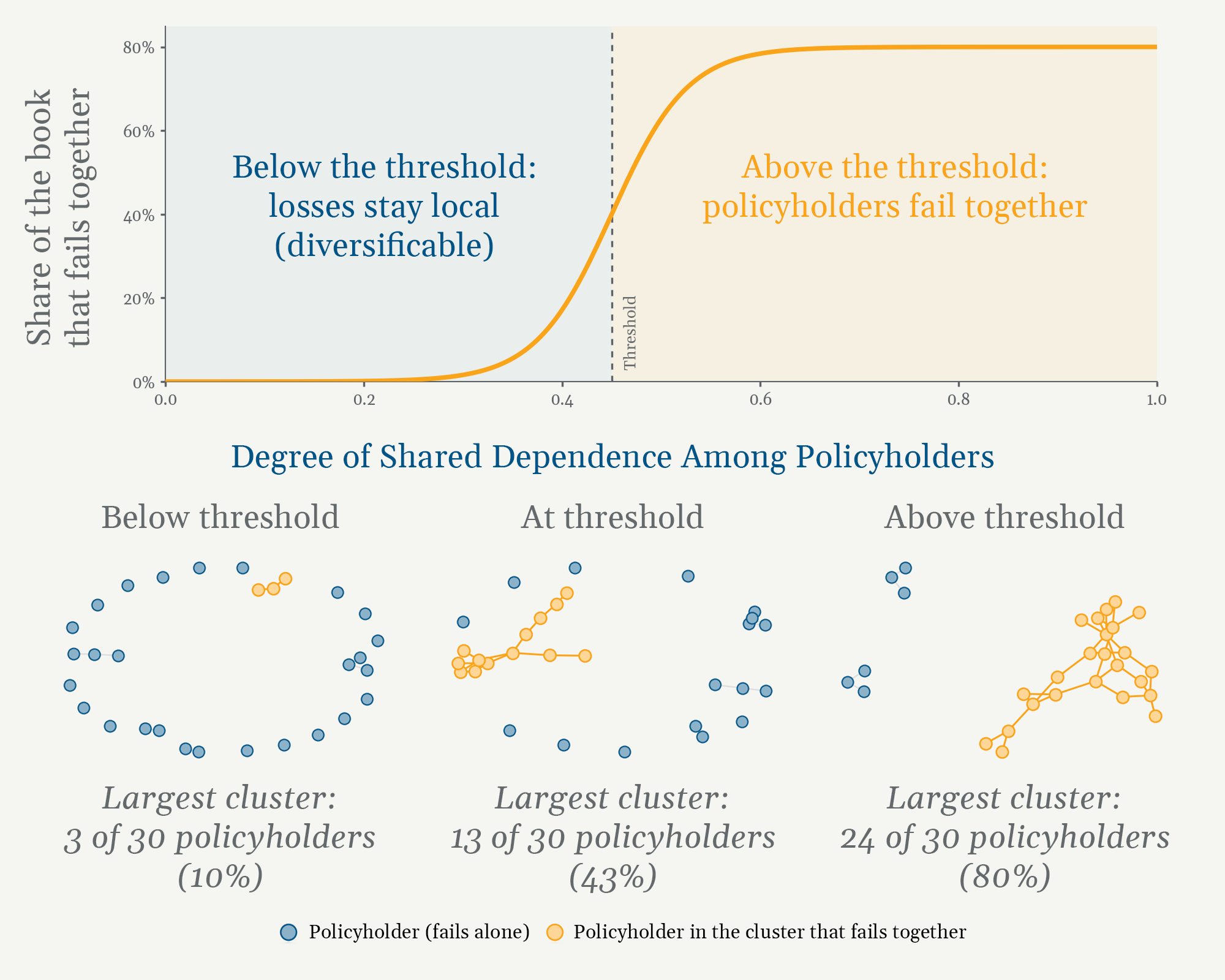
Networks give the structure a precise form. Consider a set of policyholders, connected when they depend on the same provider. As the density of shared dependence rises, the connected groups grow – but not evenly, and the change from small separate groups to a single network-spanning cluster is abrupt rather than gradual. The turn comes when each failure reaches, on average, more than one further policyholder.
This is the percolation threshold, studied in the mathematics of random networks.3 The same abrupt onset holds for networks with the uneven connectivity of real systems: below the threshold the network is a scatter of small pieces; a little past it, a single giant component appears.4 The quantity that jumps is the size of the largest group that a single failure can take down together.
From Connection to the Book
This graphic puts the transition in insurance terms: on the vertical axis, the share of the book a single provider’s failure can reach; on the horizontal axis, the degree of shared dependence among policyholders.
Share of the Book that Fails Together