New Business Demographics: Young, and Evenly Split
Across all markets where Gen Re conducts the CI Data Insights Study, the median issue age for CI insurance is typically for people in their 20s. This is not surprising given that this is when insureds start to have some form of earnings after a few years in the workforce and are planning for financial stability.
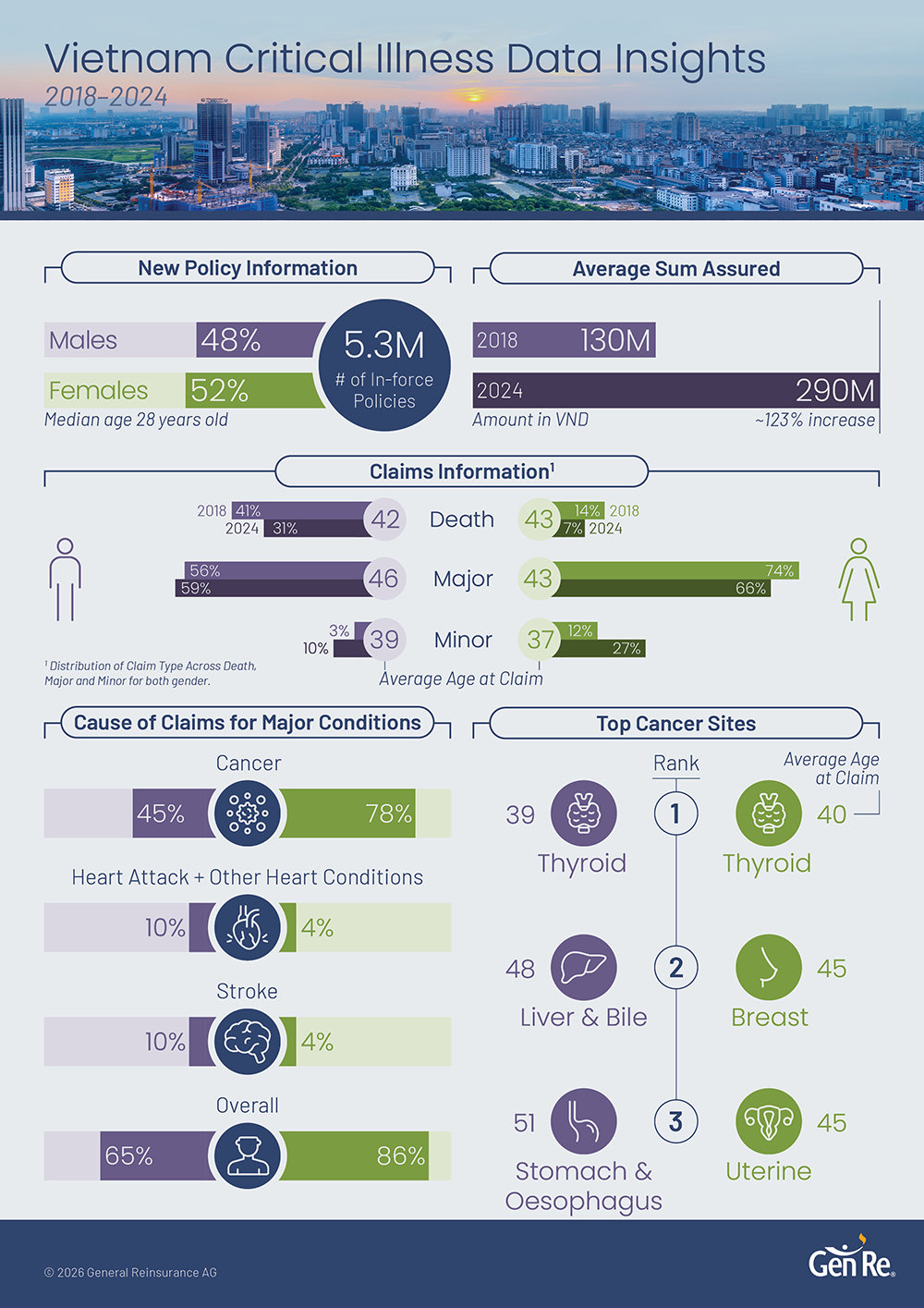
In the Vietnam study this is no different, with the median policy issue age being 28 years. Across gender, the female and male split is roughly even: female 52% and male 48%.
Protection has Outpaced Prices, from a Low Base
The CI protection gap is an important topic. The insured uses the lump sum payout of CI to fund medical treatment and loss of earnings when a CI event happens. It is therefore important for one’s level of CI protection to keep pace with inflation.
From our study, the average sum assured rose from VND 130 million (USD 5,200) in 2018 to VND 290 million (USD 11,600) in 2024, a total growth of about 123%, or 14.3% per year. This growth has outpaced general inflation, with consumer prices rising by roughly 19% in total over the period.1 The average monthly income per capita rose from VND 3.9 million (USD 156) in 2018 to about VND 5.4 million in 2024.2 The ratio of sum assured to annual income has therefore moved from roughly 2.8 times to roughly 4.5 times.
This increase in ratio of sum assured to annual income is encouraging as it shows that insureds are recognising the importance of protection. That said, insureds need to be aware that the need for CI cover sometimes comes decades after they first bought the policy. It is therefore important for insureds to have a regular review of their CI coverage from a longer horizon perspective.
Claims Experience: Fewer Deaths, More Early-Stage
Analysing the claims experience on an accelerated CI basis, the proportion of death claims has fallen for both genders: from 41% in 2018 to 31% in 2024 for males, and from 14% to 8% for females. This is promising, as we now see more insureds claiming for CI conditions rather than on death.
We are also seeing more early-stage CI claims. These have increased for both genders, from 3% to 9% for males and from 12% to 27% for females. This is a result of both a product trend, where more CI products now cover minor conditions, and an increase in earlier diagnosis.
Major CI Conditions
Often in analysis we compute the contribution of cancer, heart attack3 and stroke to overall claims for major CI and death. In the Vietnam study, these conditions accounted for 65% of male claims and 86% of female claims. This implies that despite the number of CI conditions covered in products increasing, the bulk of claims still come from a few conditions.
These proportions are likely to increase as the market develops. Referencing more developed markets such as Singapore and Hong Kong, the contribution of these conditions is 88% and 86% for males and 91% and 92% for females respectively.
Cancer Landscape: Vastly different from Other Markets
The top three cancer sites observed for males in Vietnam are thyroid, liver & bile duct, and stomach & oesophageal cancer. For females, the top three are thyroid, breast, and uterine cancer.
Thyroid cancer stands out here, as it is a site that does not typically rank highest for either gender. Another area worth highlighting is liver & bile duct cancer and stomach & oesophagus cancer for males. Other than Thailand, where liver & bile duct cancer ranks second, none of the Southeast Asian markets sees these sites in their top three.
Thyroid Cancer, and Why It Sits at the Top
Thyroid cancer is the leading claimed cancer site for both males and females, at an average claim age of 39 for men and 40 for women – the lowest ages across the top three sites in the study.
Thyroid cancer as a focus site for CI is not new. Several markets have gone through the same experience. Across our studies in Asia, we have seen mainland China move to exclude stage I thyroid cancer from the major cancer definition in 2020. Hong Kong has made a similar move, with the Hong Kong Federation of Insurers’ Best Practice on Standardization of Critical Illness Definitions4 also excluding stage I thyroid cancer from its major cancer definition.
These actions are notable: both markets had thyroid cancer among their top three cancer sites for both genders and have since moved to exclude stage I from their CI products.
In Vietnam, there are no standard CI definitions. Adopting an exclusion of stage I thyroid cancer would be one route to strengthening the sustainability of CI products.
Liver & Bile Duct, and Stomach & Oesophageal Cancer in Men
Behind thyroid, liver & bile duct, and stomach & oesophageal cancers rank higher in Vietnam than in our other Asian studies, with an average claim age of 48 and 51, respectively.
The underlying population disease burden is consistent with this. Vietnam has one of the highest age-standardised incidence rates for these sites combined in Southeast Asia, second only to Laos, at 45.3 per 100,000 for males,5 and liver & bile duct cancer is the third most common cancer among Vietnamese men and the second leading cause of cancer death nationally.6
What drives these cancers is well understood and, importantly, largely actionable. Liver cancer is strongly linked to chronic hepatitis B, which has long been endemic in Vietnam;7 stomach cancer to Helicobacter pylori, a recognised carcinogen8 estimated to infect 58.7% of adults in Vietnam;9 and heavy drinking, which raises the risk of liver and oesophageal cancer10 and probably stomach cancer11 as well, with alcohol consumption in Vietnam at about 1.7 times the world average.12 However, these are national, population-level figures rather than the current insured population. On that note, prevention potentially helps the next generation of policyholders more than the ones already in‑force.
The above risk factors set these cancers apart from thyroid cancer. Where thyroid claims largely reflect the intensity of detection, the incidence of these cancers responds to intervention, so screening and early treatment carry a different implication for portfolio management.
Breast Cancer: Low Now, with Scope for Deterioration
The breast is the second most claimed cancer site among women, with an average claim age of 45, but it accounts for a smaller share of female cancer claims than in any other market we study.
Part of that gap is likely to be detection rather than disease. Organised screening coverage in Vietnam remains limited, and awareness of signs and risk factors is lower than in the markets we compare against – so a share of cases that would be diagnosed elsewhere goes undetected here or is detected later. As screening expands and awareness improves, more of that underlying burden will surface as claims.
Underlying risk is also likely to rise. The established drivers of breast cancer incidence – later first births, fewer births, shorter breastfeeding duration – increase with economic development, and Vietnam is moving through that transition. The two effects compound so that there is better detection of existing disease against a rising base of its occurrence.
Uterine Cancer
The uterus is the third most claimed cancer site among women, with an average claim age of 45. Within that category, cervical cancer carries greater significance, because it is largely preventable.
HPV vaccination is now entering the national immunisation programme, and as a pilot: free vaccination for 11‑year-old girls in four provinces from the second half of 2026, with national expansion to follow evaluation.13 The effect on claims will take time. Girls vaccinated in 2026 will not reach the ages at which cervical cancer typically presents for two to three decades, so the programme offers little to the current in‑force portfolio.
The nearer-term effects depend on the unvaccinated cohorts who are already insured. Catch‑up vaccination and cervical screening are both available privately, and insurers are positioned to encourage take‑up, through wellness programmes, premium incentives, or simply better communication at the point of sale.
Looking Ahead
Vietnam’s CI market is young, growing, and shifting from death claims towards living benefits. That is the product working but it is also where the harder questions start.
Thyroid cancer leads both genders with the youngest claim ages in the study; the markets that got here first responded through definitions and we have started to see the Vietnam market moving towards a similar response. Liver & bile duct, and stomach & oesophageal cancers arrive at ages the product was built to cover and respond to lifestyle factors. Claims for breast and cervical cancers are under-represented due to various factors such as lack of awareness and low screening rate.
Every response from insurers costs something. Narrow the definitions and the product provides less cover; leave them and it pays for risk it never priced. Prevention avoids that choice but takes years to show. This study is there to help make the decision an informed one and we give our thanks to the companies that make it possible.
For questions about the study or future participation, please get in touch with the CI Analytics team.